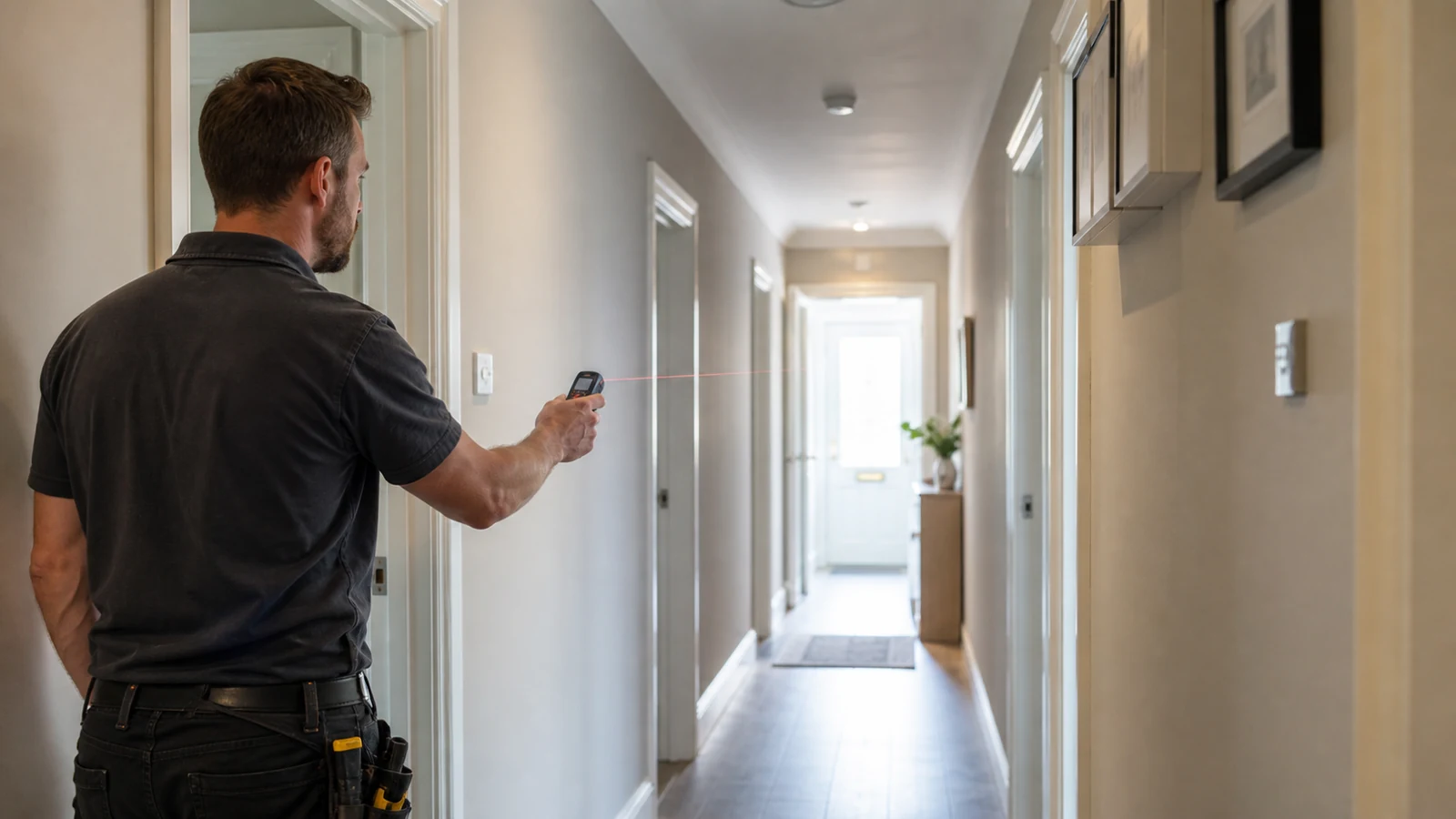
Continuous Measurement Mode Laser Measure Uk
Direct answer: continuous measurement mode, often called tracking mode, keeps updating the displayed distance as you move the laser measure. It is useful for sweeping a wall, finding a target distance, checking clearances and rehearsing room layouts, but it is not the right mode for every final quote reading.
What the mode does
A UK listing for the Industrial Tool Supplies Stanley TLM99 describes continuous tracking as a way to find distance from a target quickly for decorating-related tasks. The Bob Vila laser measure explainer gives the general principle: the tool keeps updating as it moves. Some models also include min/max style functions; the UK Power Tools Bosch UniversalDistance 50C listing is one example from the category. Do not assume your own meter has min/max unless its manual says so.
When to use continuous instead of single-shot
- Finding where a cabinet, panel, rail or fixture should land from a fixed wall.
- Sweeping a hallway to understand the changing distance while walking.
- Checking whether a room has an obvious longest or shortest clear span.
- Setting a rough position before taking a final single-shot reading.
- Explaining a measurement process to a helper before recording the final number.
Continuous sweep checklist
- Read the Class 2 laser safety guide and make sure the beam path is clear.
- Set the correct start point using the reference point guide.
- Choose a target surface that is flat, stable and easy for the laser to read.
- Hold the meter square to the target rather than waving it in an arc.
- Move slowly until the display reaches the value or position you need.
- Lock, note or repeat the reading according to your device instructions.
- For quotes, confirm the important dimension with a deliberate single-shot reading.
Stop conditions
Stop the sweep if someone walks into the beam path, if the reading jumps around on a poor target, if bright outdoor conditions make the display unreliable, or if the measurement will be used for safety-critical positioning. Continuous mode is a convenience feature; it should not replace a verified method where the consequences of being wrong are serious.
How it helps decorators
For a decorator room workflow, continuous mode is most useful before the final notes: sweeping for clearances, finding a target distance, or checking that a wall is broadly consistent. The final quote still benefits from clean single measurements, written assumptions and a quick verification step.