Laser Distance Meter: A UK Buyer's Guide
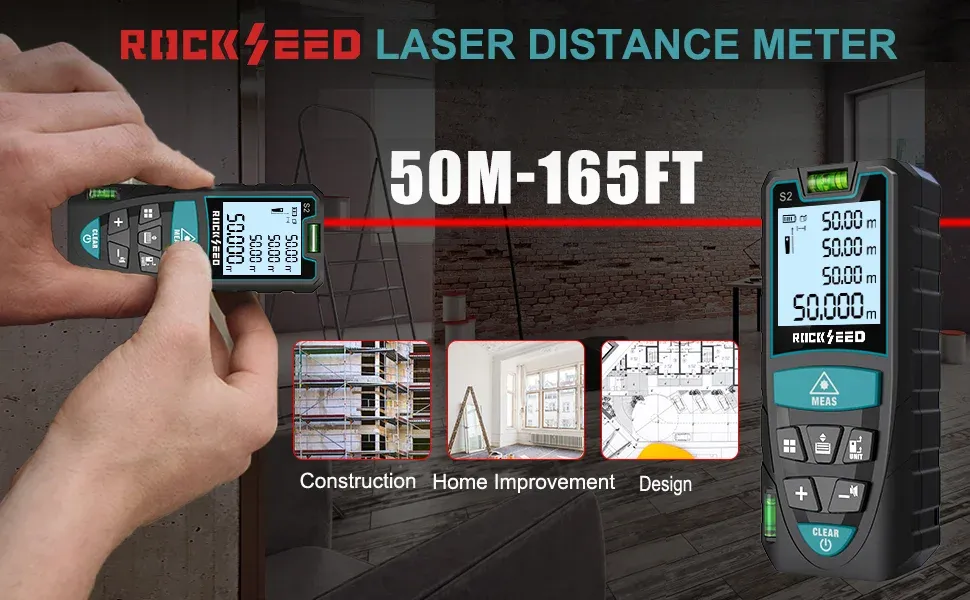
A practical UK buyer's guide to the laser distance meter: how range, ±2mm accuracy, measuring modes and data storage decide which tool suits surveying, property inspections and room-by-room work — and where the RockSeed 100m fits for the money.
What Is a Laser Distance Meter and Why Does It Matter?
A laser distance meter is a handheld electronic tool that calculates distance by timing how long a laser pulse takes to bounce back from a surface. Simple concept. Massive time savings on site.
Honestly, I remember watching a joiner on a Manchester city centre refit spend twenty minutes with a tape measure trying to get ceiling heights in an awkward stairwell. Painful. A decent laser measurer would've had that sorted in seconds — and with better accuracy too, typically ±1.5mm over 10 metres.
For UK tradespeople working across construction, fit-out, and surveying, these tools aren't a luxury anymore. They're standard kit. The Health & Safety Executive increasingly references lone-working risk assessments where eliminating the need for a second person to hold a tape end is a genuine safety improvement. You know what I mean?
Who Needs One?
Electricians calculating cable runs. Carpet fitters quoting square meterage. Surveyors doing measured building surveys. Estate agents — well, actually, they probably need one more than anyone given how often room dimensions are wrong on listings. If you measure anything professionally, a laser distance tool pays for itself inside a week.
What to Look for in a Laser Distance Meter
If you measure rooms and buildings for a living, five things decide whether a laser distance meter earns its place in your bag:
- Range. A 100m tool covers whole floors, long boundaries and building elevations in one shot; 30–50m units run out on bigger surveying jobs.
- Accuracy. ±2mm is fine for room surveys, quotes and material take-offs; ±1mm only matters for conservation or dispute-grade work.
- Modes. Distance, continuous, area, volume and Pythagorean (indirect height) cover almost every property measurement without a separate calculator.
- Storage. Onboard memory — the RockSeed 100m stores 20 groups of readings — saves scribbling numbers when you work through several rooms back to back.
- Readability and build. A backlit screen for dim lofts and cellars, dual bubble levels for square readings, and an IP54 rating for dusty, splashy sites.
Premium brands add extras such as Bluetooth export and a pointfinder camera, but they cost considerably more; for most surveying and property work the fundamentals above matter far more than the badge.
How Laser Measurement Sensor Technology Works
Two main technologies dominate: phase-shift measurement and time-of-flight (ToF). Understanding the difference helps you pick the right tool for your application.
Phase-Shift (Most Common in Handheld Units)
The laser emits a modulated beam. The sensor compares the phase of the outgoing signal against the returning signal. The phase difference corresponds directly to distance. This method delivers ±1.0mm to ±1.5mm accuracy at ranges up to 200m and works brilliantly indoors.
Time-of-Flight (Pulsed)
Used more in total stations and longer-range devices. A short pulse fires, and the sensor measures the return time directly. Less common in budget handhelds because the timing circuits need to be incredibly precise — we're talking picosecond resolution for millimetre accuracy. Not cheap to engineer properly., meeting British quality expectations
The Laser Itself
Almost all consumer and professional laser measuring devices use a Class 2 red laser diode at 635nm wavelength, with output power below 1mW. This complies with BSI standards (BS EN 60825-1) for eye safety without requiring protective eyewear. Some newer models from Leica use a green 520nm laser — more visible to the human eye, which helps outdoors but drains batteries faster.
The sensor receiving the return signal is typically a PIN photodiode or avalanche photodiode (APD). APDs offer better sensitivity for long-range work but cost more to manufacture, which is partly why survey-grade instruments cost considerably more.
Head-to-Head Comparison: Laser Distance Meter Options for 2026
Rather than quote fast-moving prices for every brand, here is how the main options compare on the specifications that actually change a measuring day. Premium meters cost considerably more than budget and mid-range tools.
| Option | Typical range | Typical accuracy | Data storage | Best for |
|---|---|---|---|---|
| Budget high-street units | 20–40m | ±3mm | Usually none | Occasional DIY checks |
| RockSeed 100m Laser Measure (£67.22) | 100m / 328ft | ±2mm | 20 groups | Value professional and serious DIY |
| Mid-range brand meters | 50–80m | ±1.5mm | A few readings | General trade use with app export |
| Premium brand meters | 100–150m | ±1mm | Extensive + Bluetooth | Commercial fit-out and survey-grade work |
The takeaway for most UK buyers: a 100m tool such as the RockSeed 100m laser measure at £67.22 gives full-floor range, ±2mm accuracy, 5-in-1 modes and 20-group storage at a fraction of premium-brand prices. Step up to a premium meter only if you need survey-grade ±1mm, Bluetooth export or a pointfinder camera for long outdoor shots.
Best Value Laser Distance Meter Picks for UK Tradespeople
Value is not just the lowest price — it is matching what you pay for to what you actually measure.
Best all-round value: RockSeed 100m Laser Measure (£67.22)
For surveyors, kitchen fitters, decorators and anyone measuring rooms all day, this is the sweet spot: 100m range, ±2mm accuracy, dual bubble levels, 5-in-1 modes and 20-group storage. For interior survey and take-off work the ±2mm figure is rarely the limiting factor, and the onboard memory keeps a whole property's readings in one place.
When to spend more
If you carry out measured building surveys for architectural practices, or work on heritage buildings where ±1mm matters for conservation specifications, invest in a premium survey-grade meter with Bluetooth export and a pointfinder camera. For everyday domestic and light-commercial measuring, a well-specified 100m tool covers it.
Frequently Asked Questions
How accurate is a laser distance meter compared to a tape measure?
A quality laser distance meter typically achieves ±1mm to ±2mm accuracy up to 100 metres. A steel tape is accurate to about ±1mm over short distances but introduces sag error beyond 5 metres. For anything over 3 metres, a laser is more consistent and removes the parallax reading errors that affect tapes.
Can a laser distance meter work outdoors in bright sunlight?
Yes, with limitations. The laser dot becomes hard to see beyond 10–15 metres in direct sun. A target plate propped at the far point restores usable range to the full specification, and premium meters with a pointfinder camera show the target on-screen instead.
What is the best laser distance meter for room and property surveys?
For measuring rooms and whole properties, choose a 100m tool with area, volume and Pythagorean modes plus onboard storage. The RockSeed 100m laser measure at £67.22 covers this with ±2mm accuracy, dual bubble levels and 20-group memory, which is enough for the vast majority of survey and take-off work.
Do laser distance meters need calibration?
For general trade and survey use, no routine calibration is required. If readings are used for legal or contractual purposes, annual calibration to ISO 16331-1 is sensible. Any unit can be sense-checked against a known distance — a 10m hallway measured with a calibrated steel tape works well.
Are budget laser measures reliable?
Reliability depends on quality control, not headline price. Units bought through an established UK supplier with UKCA marking and proper warranty support are dependable for daily use. Very cheap direct imports without UK certification may lack safety compliance and warranty cover.
Key Takeaways
- Range, accuracy, modes and storage — in that order — decide which laser distance meter suits surveying and property work.
- A 100m tool such as the RockSeed 100m laser measure (£67.22) offers full-floor range with ±2mm accuracy, enough for the vast majority of survey and take-off jobs.
- Phase-shift sensor technology gives modern handhelds reliable accuracy without the cost of time-of-flight total stations.
- Premium brands cost considerably more and add Bluetooth export, a pointfinder camera and survey-grade ±1mm — worth it only for measured surveys or conservation work.
- For outdoor shots beyond about 15 metres, use a target plate or a meter with a pointfinder camera, because the dot is hard to see in sunlight.
- Calibration is only needed for legal or contractual measurement; general trade use does not require it.
Ready to upgrade your toolkit with RockSeed?
View RockSeed 100m Laser Measure — £67.22 · Free UK Delivery